

product Details
Explore More
Alternatives
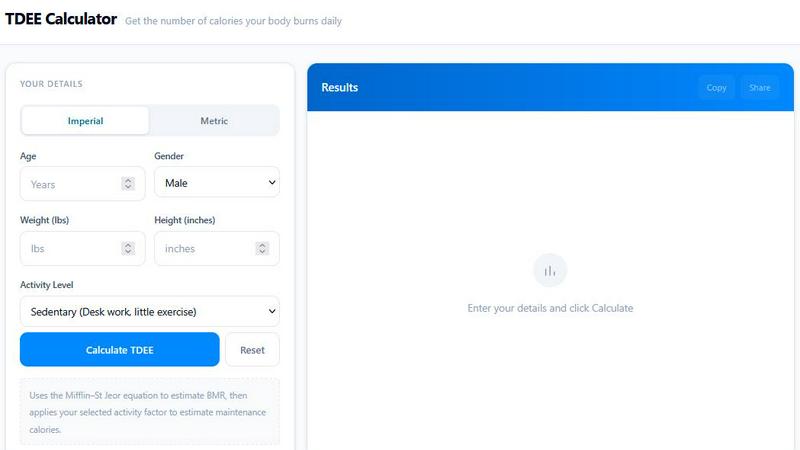
About TDEE Calculator
TDEE Calculator is a fast, accurate, and completely free online tool designed to help you estimate your Total Daily Energy Expenditure (TDEE) and plan your daily calorie intake with confidence. Whether your goal is to lose weight, build muscle, or maintain your current physique, this calculator provides a reliable starting point based on proven scientific formulas, not guesswork. By entering your age, sex, height, weight, and activity level, you can instantly calculate your maintenance calories and receive practical targets for calorie deficits or surpluses. The tool is built for individuals who want a clear, data-driven approach to nutrition and fitness, from beginners taking their first steps in health tracking to experienced athletes fine-tuning their energy balance. TDEE Calculator uses the well-researched Mifflin-St Jeor equation to estimate your Basal Metabolic Rate (BMR), then applies an appropriate activity factor to deliver a personalized daily calorie estimate. Beyond the core calculation, the tool offers valuable insights including macro guidance, activity-based adjustments, and practical recommendations for adjusting your intake based on real-world results. The interface is designed for speed and clarity, allowing you to get your results in seconds without unnecessary complexity. The tool is entirely free to use, with no hidden fees or subscription requirements, making it accessible to anyone seeking to understand their body's energy needs. TDEE Calculator is ideal for meal planning, weight management, performance optimization, and general health awareness, giving you a simple yet powerful foundation for making informed dietary decisions.
Features
Accurate Mifflin-St Jeor Equation
TDEE Calculator employs the Mifflin-St Jeor equation, which research published in the American Journal of Clinical Nutrition has validated as one of the most accurate methods for estimating resting metabolic rate in healthy adults. This formula calculates your Basal Metabolic Rate (BMR) using your weight in kilograms, height in centimeters, and age, with separate equations for men and women. The result is a scientifically grounded baseline that forms the foundation for your personalized TDEE estimate.
Customizable Activity Level Selection
The calculator offers five distinct activity levels ranging from Sedentary (1.2) to Athlete (1.9), allowing you to accurately reflect your typical daily movement and exercise habits. Each level comes with a clear description, such as desk work with little exercise for Sedentary or twice-daily training for Athlete. This flexibility ensures your TDEE estimate accounts for the calories burned through both planned workouts and routine daily activities.
Instant Calorie Deficit and Surplus Recommendations
After calculating your maintenance calories, TDEE Calculator provides immediate guidance on calorie deficits for fat loss and surpluses for muscle gain. For fat loss, the tool suggests a daily deficit of roughly 250 to 500 calories, while for building muscle, a surplus of about 200 to 350 calories is recommended. These practical targets help you create a structured plan that aligns with your specific fitness goals.
Macro Guidance and Practical Insights
Beyond total calorie numbers, the calculator offers macro guidance to help you divide your daily intake into protein, carbohydrate, and fat targets that match your training style and lifestyle. It also provides activity-based adjustments and tips for monitoring your progress over time. The tool emphasizes treating your TDEE as a starting estimate, with advice to track your weight for two to three weeks and adjust by 100 to 200 calories as needed based on real-world results.
Use Cases
Weight Loss Planning and Calorie Deficit Management
Individuals aiming to lose weight can use TDEE Calculator to determine their maintenance calories and then establish a consistent calorie deficit. By knowing exactly how many calories their body burns daily, users can create a structured eating plan that promotes steady fat loss without extreme restriction. The tool's deficit recommendations help users avoid overly aggressive cuts that could harm metabolism or energy levels, making weight loss more sustainable and effective over time.
Muscle Building and Surplus Calorie Targeting
For those focused on building muscle mass, the calculator provides a precise surplus calorie target that supports muscle growth while minimizing unwanted fat gain. Bodybuilders, strength athletes, and fitness enthusiasts can use the TDEE estimate to ensure they are eating enough to fuel recovery and hypertrophy without overeating. The macro guidance further helps users optimize their protein intake, which is critical for muscle repair and growth.
Maintenance and Performance Optimization
Athletes and active individuals can use TDEE Calculator to fine-tune their calorie intake for peak performance and body weight stability. By recalculating after changes in training volume or body composition, users can ensure they are fueling their workouts adequately while avoiding unintentional weight gain or loss. This use case is particularly valuable for endurance athletes, competitive sports participants, and anyone with physically demanding jobs who needs to maintain energy balance.
Meal Planning and Nutritional Strategy Development
Nutrition coaches, dietitians, and individuals managing their own nutrition can leverage TDEE Calculator as a foundational tool for building personalized meal plans. The calorie estimate serves as a starting point for dividing daily intake into meals and snacks, while the macro guidance helps users prioritize nutrient-dense foods. This use case supports long-term dietary adherence by providing a clear, measurable target that can be adjusted based on progress and feedback from the body.
Frequently Asked Questions
What does TDEE mean?
TDEE stands for Total Daily Energy Expenditure, which is the total number of calories your body burns over an entire 24-hour period. This includes the energy needed for basic life-sustaining functions at rest (Basal Metabolic Rate), the energy required to digest and process food (thermic effect of food), and the calories burned through all physical movement and exercise (activity thermogenesis). Understanding your TDEE is essential for managing body weight, as consuming fewer calories than your TDEE leads to weight loss, while eating more supports weight gain.
How is TDEE different from BMR?
BMR, or Basal Metabolic Rate, is the number of calories your body needs to perform basic life functions while at complete rest, such as breathing, circulation, and cell production. TDEE is a broader measure that includes BMR plus all additional energy expended through daily activities, exercise, and digestion. In simple terms, BMR is the baseline energy requirement for survival, while TDEE represents your actual total calorie burn on a typical day. The calculator first estimates your BMR using the Mifflin-St Jeor equation, then multiplies it by an activity factor to determine your TDEE.
How accurate is this calculator?
The Mifflin-St Jeor equation used by TDEE Calculator is considered one of the most accurate formulas for estimating resting metabolic rate in healthy adults, according to research. However, the final TDEE estimate is still a starting point, as individual variations in metabolism, muscle mass, and daily activity can affect actual energy expenditure. The tool recommends using your TDEE consistently for two to three weeks while monitoring your body weight; if your weight stays stable, the estimate is likely close, while ongoing gain or loss suggests you should adjust by about 100 to 200 calories and reassess.
Should I recalculate after losing weight?
Yes, it is highly recommended to recalculate your TDEE after significant weight loss or gain. As your body weight changes, your Basal Metabolic Rate also changes because a smaller body requires fewer calories to maintain basic functions. Recalculating ensures your calorie targets remain accurate and effective for your current body composition. The tool suggests recalculating after changes of approximately 10 pounds or more, or whenever your activity level shifts significantly, to keep your nutrition plan aligned with your evolving needs.
Similar to TDEE Calculator


Caesura
Caesura is a macOS menu-bar app that reminds you to drink water, stretch, rest your eyes, and breathe on science-backed intervals.

Holly AI
Holly AI automates patient scheduling and front desk tasks to help clinics grow without burnout.

Droidal Insurance Verification AI Agent
Droidal Insurance Verification AI Agent ensures real-time eligibility checks, reducing denials and streamlining patient data for seamless care.