

LLM Reference
LLM Reference helps tech leaders quickly find, compare, and pick the best AI model and provider for their specific project needs.
product Details
Explore More
Alternatives
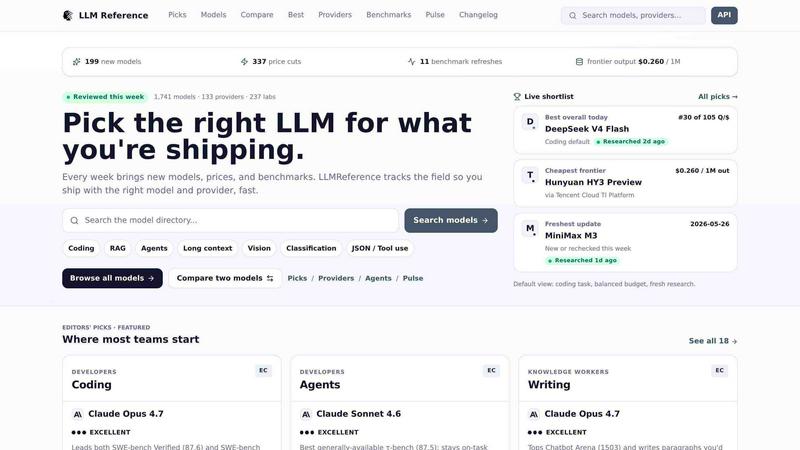
About LLM Reference
LLM Reference is a comprehensive decision-support directory built specifically for engineers, technical leaders, and AI practitioners who need to select the optimal large language model (LLM) and provider in the rapidly evolving AI landscape. The platform tracks over 1,800 language models from more than 140 providers and 247 research labs, with data refreshed weekly to include new releases, verified price changes, and benchmark updates. The core value proposition is eliminating the time wasted hunting through scattered sources, allowing teams to ship with confidence. Whether you are building a coding assistant, an agentic workflow, a writing tool, a research pipeline, or a creative application, LLM Reference provides a single, trustworthy place to compare models side-by-side, identify the cheapest pricing for frontier output, and browse curated editors' picks for specific tasks including coding, agents, writing, research, image generation, and video creation. The site is designed for fast triage, enabling users to quickly identify the right model for their job, determine the most cost-effective provider, and get back to building. With a Pulse feed that highlights weekly changes including new models, price cuts, and benchmark refreshes, LLM Reference keeps users informed without the noise. It is built by the Data Advantage project and updated daily, making it an essential resource for anyone who needs to stay current with the exploding LLM ecosystem.
Features
Comprehensive Model Directory
LLM Reference maintains an extensive, searchable directory of over 1,800 language models from more than 140 providers and 247 research labs. Users can search by model name, provider, task type, or specific capabilities such as coding, RAG, agents, long context, vision, classification, or JSON and tool use. The directory is updated weekly, ensuring that new releases and changes are captured promptly, making it a reliable source for comparing the latest models in the market.
Curated Editors' Picks
The platform features expert-curated editors' picks for specific use cases, helping users start with the most recommended models for their task. These picks are organized by audience categories including developers (coding, agents, tool use, open weights, long context, cheap), knowledge workers (writing, research, summarization, docs Q&A, translation, data and SQL), and creatives (image, video, voice TTS, transcription, music, image editing). Each pick includes a quality rating and a brief explanation of why the model excels in that domain.
Pulse Feed and Weekly Updates
The Pulse feed provides a real-time snapshot of what changed in the model market each week, including counts of new models, verified price cuts, and benchmark refreshes. For example, recent updates show 177 new models, 53 price cuts, and 368 benchmark refreshes in a single week. This feature keeps users informed about the latest developments without requiring them to manually track multiple sources, reducing information overload.
Side-by-Side Model Comparison
LLM Reference offers a dedicated comparison tool that allows users to compare two models side-by-side across key metrics, including performance benchmarks, pricing, and provider details. This feature is essential for making informed decisions when choosing between similar models, such as comparing Claude Fable 5 versus Claude Opus 4.8 or GPT-5.5 versus Gemini 3.1 Pro Preview. The comparison tool helps users quickly identify which model offers the best performance for their specific needs and budget.
Use Cases
Selecting a Coding Assistant Model
Engineering teams building coding assistants or developer tools can use LLM Reference to identify the best model for code generation and debugging tasks. The platform highlights top coding models like Claude Fable 5, which achieves 80.3% on SWE-bench Pro and 96% on SWE-bench Verified, making it the recommended production coding pick for non-trivial engineering tasks. Users can filter by coding-specific benchmarks and compare pricing across providers to find the most cost-effective solution.
Choosing an Agentic Workflow Model
Teams developing autonomous agents or multi-step workflows can leverage LLM Reference to select models optimized for agentic tasks. The editors' picks for agents recommend models like Claude Sonnet 4.6, which scores 87.5 on tau-bench and demonstrates strong self-correction capabilities across long tool loops. Users can explore the agents board to see all eligible models and compare their performance on relevant benchmarks before integrating them into production systems.
Evaluating Models for Research and Analysis
Knowledge workers and researchers can use LLM Reference to find models that excel at research, summarization, and data analysis. The platform's research board highlights Claude Fable 5 as the strongest general knowledge-work pick, with a GDPval-AA ELO of 1932 and strong performance in finance, trading, and analytics tasks. Users can also explore dedicated boards for summarization, translation, and data and SQL to find the best model for their specific research pipeline.
Finding Cost-Effective Image and Video Generation
Creative professionals and media teams can use LLM Reference to identify the most cost-effective models for image and video generation. The platform tracks frontier output pricing, currently showing the cheapest at $0.260 per 1M output tokens via Hunyuan HY3 Preview on Tencent Cloud TI Platform. Editors' picks for image generation recommend FLUX.2 Dev for photorealistic output, while Veo 3.1 is recommended for video with 30-second clips, native audio, and up to 4K resolution through Vertex AI.
Pricing
LLM Reference itself is a free resource for browsing models, providers, benchmarks, and editors' picks. The platform does not charge users for accessing the directory, comparison tools, or Pulse feed. However, the pricing information displayed on the site reflects the costs charged by third-party providers for using their models, such as the current cheapest frontier output at $0.260 per 1M tokens via Hunyuan HY3 Preview on Tencent Cloud TI Platform. Users should verify pricing directly with providers before making purchasing decisions.
Frequently Asked Questions
How often is the model data updated on LLM Reference?
The data on LLM Reference is refreshed weekly to include new model releases, verified price changes, and benchmark updates. Additionally, the Pulse feed highlights what changed in the current week, including counts of new models, price cuts, and benchmark refreshes. The platform is built by the Data Advantage project and updated daily, ensuring users always have access to the most current information about the LLM ecosystem.
Can I compare two specific models side by side?
Yes, LLM Reference provides a dedicated comparison tool that allows users to compare two models side-by-side. Users can search for any two models and view their performance benchmarks, pricing details, and provider information in a single view. The platform also features a cheat sheet with most-asked comparisons, such as Claude Fable 5 versus Claude Opus 4.8 or GPT-5.5 versus Gemini 3.1 Pro Preview, to help users quickly evaluate popular alternatives.
What types of use cases does LLM Reference cover?
LLM Reference covers a wide range of use cases organized into three main audience categories: developers (coding, agents, tool use, open weights, long context, cheap), knowledge workers (writing, research, summarization, docs Q&A, translation, data and SQL), and creatives (image, video, voice TTS, transcription, music, image editing). Each category has dedicated boards with curated editors' picks and multiple eligible models, allowing users to find the best model for their specific task.
How does LLM Reference determine its editors' picks?
Editors' picks on LLM Reference are determined by expert analysis of model performance across relevant benchmarks, pricing, and real-world applicability. Each pick includes a quality rating, such as Excellent, and a brief explanation of why the model excels in that domain. For example, Claude Fable 5 is rated Excellent for coding due to its 80.3% SWE-bench Pro score and 96% SWE-bench Verified score. The picks are regularly updated as new models and benchmark results become available.
Similar to LLM Reference

WidgIq
Provide an AI-powered customer support widget for your website
Screen Issues
Free Online Screen Test Tool - Instantly diagnose dead pixels, lines, color issues, and flickering. Multiple test modes, no download needed.

ContextBolt SEO
Research keywords, competitors, backlinks and AI visibility in Claude or Codex. Keep the findings in your SEO dashboard.