

product Details
Explore More
Alternatives
About act101
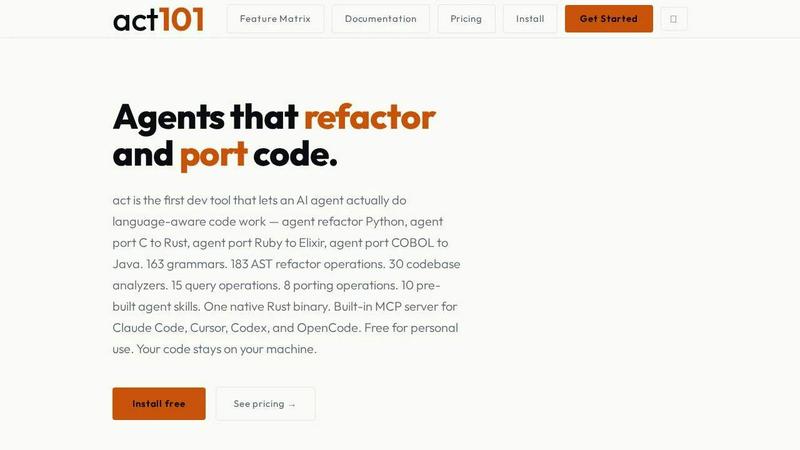
act101 is a groundbreaking developer tool that empowers AI coding agents to perform language-aware code refactoring and porting across 163 programming languages. Unlike traditional AI coding assistants that rely on whole-file rewrites, which often break formatting, lose comments, and lack undo capabilities, act101 provides a suite of 183 Abstract Syntax Tree (AST) refactor operations, 30 codebase analyzers, 15 query operations, and 8 porting operations. These capabilities are exposed through a built-in Model Context Protocol (MCP) server, making act101 compatible with popular AI coding environments like Claude Code, Cursor, Codex, and OpenCode. The product is engineered as a single native Rust binary, ensuring no plugin runtime, no package graph dependencies, and zero supply-chain attack surface. act101 operates without indexing or caching, parsing code on each call to guarantee results are never stale, and all processing happens locally on the user's machine with no telemetry or code exfiltration. This tool is designed for professional developers and engineering teams who need precise, AST-aware code transformations that preserve comments, formatting, and cross-file consistency, while enabling complex migrations between languages like C to Rust, Ruby to Elixir, or COBOL to Java. act101 is free for personal use, making advanced AI-driven code engineering accessible to individual developers while offering scalable solutions for teams.
Features
183 AST Refactor Operations
act101 provides an extensive library of 183 AST-aware refactor operations that enable AI agents to perform precise code transformations across 163 languages. These operations include extract-function, rename, move-symbol, inline, convert-to-dataclass, extract-trait, add-type-hints, generate-init, and organize-imports. Each operation operates on the code's abstract syntax tree, ensuring structural integrity, cross-file consistency, and preservation of comments and formatting. The agent can automatically checkpoint before each operation and instantly undo any change, providing a safe and iterative refactoring workflow that eliminates the risks associated with whole-file rewrites.
8 Porting Operations for Cross-Language Migration
act101 introduces a sophisticated state machine for porting code between any two of the 163 supported grammars. The porting workflow consists of four core operations: port_contract to anchor the source-to-target migration, port_inventory to enumerate every symbol that must move, port_order to resolve dependency ordering, and a port_manifest state machine (init, add, update, remove, note) to track progress step by step. This structured approach enables AI agents to systematically migrate complex codebases, such as porting C libraries to Rust, Ruby applications to Elixir, or legacy COBOL systems to Java, while maintaining logical consistency and dependency integrity.
30 Codebase Analyzers
The tool includes 30 built-in analyzers that give AI agents a comprehensive structural understanding of a codebase before making any changes. These analyzers assess cohesion, coupling, cycles, chokepoints, hotspots, dead code, layers, seams, clusters, surface area, fan balance, migration readiness, and type completeness. By providing a deep structural map of the repository, act101 enables agents to make informed decisions about refactoring priorities, identify problematic dependencies, detect architectural issues, and plan migration strategies with greater accuracy and efficiency.
10 Pre-Built Agent Skills
act101 comes with 10 pre-built agent skills that compose its operations into common engineering workflows. These skills include architecture-audit, code-review, refactoring, code-navigation, code-generation, migration-assessment, boundary-analysis, change-impact, health-check, and architectural-refactoring. Developers can invoke these skills with simple commands like /skill-name in Claude Code, Cursor, or other MCP-aware clients. Each skill orchestrates multiple operations to deliver a complete workflow, such as performing a full architecture audit that combines analyzers, query operations, and refactoring steps into a single automated process.
Use Cases
Automated Code Refactoring Across a Large Codebase
A development team needs to refactor a large Python monorepo to improve code quality and maintainability. Using act101, an AI agent can systematically apply operations like extract-function to break down monolithic functions, rename symbols to follow consistent naming conventions, and organize imports across hundreds of files. The agent can work through the entire codebase with AST-aware precision, automatically checkpointing before each change and providing instant undo if any transformation introduces issues. This reduces the manual effort of refactoring from weeks to hours while ensuring no code is broken.
Cross-Language Migration of Legacy Systems
An enterprise needs to port a legacy COBOL banking application to Java to modernize its technology stack. act101 enables an AI agent to drive this migration using the port_contract, port_inventory, port_order, and port_manifest operations. The agent systematically identifies every symbol, resolves dependency ordering, and tracks migration progress through a state machine. The AST-aware operations ensure that the generated Java code maintains the original business logic while adapting to Java's syntax and idioms, significantly reducing the risk and cost of manual migration.
Architecture Audit and Technical Debt Assessment
A software architect wants to assess the health and structural integrity of a TypeScript codebase before a major release. Using act101's architecture-audit skill, an AI agent runs multiple analyzers to detect coupling issues, cyclic dependencies, dead code, and hotspots. The agent generates a comprehensive report that highlights problematic areas, suggests refactoring priorities, and identifies migration readiness for potential technology changes. This enables the architect to make data-driven decisions about where to focus improvement efforts.
Real-Time Code Review with Structural Analysis
During a code review process, a senior developer uses act101 to analyze a pull request for a Rust project. The AI agent runs the code-review skill, which combines coupling analysis, boundary detection, and change-impact assessment. The agent can identify if the proposed changes introduce new dependencies that violate module boundaries, detect potential dead code from the changes, and suggest refactoring improvements. The developer can then iterate with the agent to refine the code before merging, ensuring higher code quality and reducing review cycles.
Pricing
act101 is free for personal use, providing individual developers full access to all features including 183 AST refactor operations, 30 codebase analyzers, 8 porting operations, and 10 pre-built agent skills. For teams and commercial use, act101 offers a pricing model that scales with usage and team size. Specific pricing tiers for professional and enterprise plans are available on the act101 website, where you can find detailed information about feature limits, support levels, and licensing options for organizations.
Frequently Asked Questions
How does act101 ensure my code stays private and secure?
act101 is designed with privacy and security as core principles. All code processing happens locally on your machine with no indexing, caching, or telemetry. The tool is a single native Rust binary with no plugin runtime, no package graph dependencies, and zero supply-chain attack surface. Your code never leaves your machine, and there is no data exfiltration. The only potential external communication is for license verification, which may contact our servers to validate your license key.
What programming languages does act101 support?
act101 supports 163 programming languages through its grammar definitions. This includes all major languages like Python, Rust, TypeScript, Go, Java, C, C++, Ruby, Elixir, and COBOL, as well as many niche and legacy languages. The tool can perform AST-aware refactoring and porting operations between any two supported languages, making it versatile for diverse technology stacks and migration projects.
How does act101 compare to using AI for whole-file rewrites?
Traditional AI coding assistants perform whole-file rewrites that often break formatting, lose comments, and have no undo capability. act101 operates at the AST level, performing precise operations like extract-function, rename, and move-symbol that preserve comments, formatting, and cross-file consistency. Each operation includes automatic checkpointing and instant undo, providing a safe, iterative workflow. Benchmark averages show act101 uses approximately 85% fewer tokens than file-based operations, making it more efficient and cost-effective.
Can act101 be integrated with my existing AI coding tools?
Yes, act101 is built as a Model Context Protocol (MCP) server, making it compatible with any MCP-aware client. It works seamlessly with Claude Code, Cursor, Codex, Windsurf, and OpenCode. Integration is straightforward: you install the act101 binary and configure your AI coding tool to connect to its built-in MCP server. Once connected, your AI agent can access all 183 refactor operations, 30 analyzers, 8 porting operations, and 10 pre-built skills directly within your existing workflow.
Similar to act101

Product Launch Checklist
A free launch checklist for SaaS, apps, AI tools and more. Every step says why it matters and when you can skip it.

Forms Plugin
The #1 Native Form Builder Plugin for Framer - No Code, No Embeds, No External Platforms.

Chatit Me - Free Random Chat Alternative
Chat with random strangers online for free on ChatIt.me. Enjoy safe, anonymous, and instant 1-on-1 conversations with people worldwide

Xeramail Temp Mail
Free temp mail and temporary email from Xeramail. Get a disposable email address instantly, no sign-up.

Video2URL
Turn videos, images, and files into secure direct links for sharing, embedding, and automated workflows.

VidhyaGen
Fast, free, and privacy-focused online tool to convert image formats instantly without losing quality. Built for web users and creators.

Screen Beaver
Create product videos manually or let your AI agent control Screen Beaver through MCP—no mouse or keyboard needed.